I Know the Map. Why Do I Blank on Geography Trivia?
A long strip of coastline at the edge of a map can bring a country’s name to mind in a second. Take the map away and ask for “a South American country on the Pacific,” and you might spend half the clock looking at an imaginary globe. The coastline gave you somewhere to start. The written question leaves you to find that first landmark yourself. Try the two versions below and see where you hesitate.
First, take a look at the outline
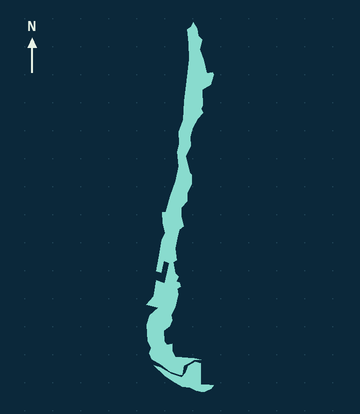
Give yourself one guess. What did you actually use? Perhaps it was the length, perhaps the islands at the bottom, perhaps a memory of running your finger down the side of South America in a school atlas. Now cover the picture or scroll until it disappears. Say the name of a country that borders the one in the picture. That second question is only a few words longer, but the shape has stopped doing much of the work.
Reveal the country and check a neighbour
The outline is Chile. Its land neighbours are Peru, Bolivia and Argentina. If you pictured the Andes and said Argentina, you found one route to an answer. If you followed the coast north and came up with Peru, that works too.
The daily silhouette in Worldle gives you one country or territory to identify. A wrong guess can still tell you the distance and direction to that target. Our geography practice can ask for any member of a group. Several answers may fit, and the text tells you which group counts. Being good at identifying outlines gives you plenty of material for that game. The trick is finding a way into it when there’s no picture.
Change one line of the question
Imagine a friend has put the map face down. They can turn the exercise into three quite different questions without getting another map out. Read each one before looking across to the next column.
| Your friend asks | Where to start | What settles it |
|---|---|---|
| Which country was in the picture? | Recall the long strip and the islands at its southern end. | One name identifies that outline. |
| Name a country on South America’s Pacific coast. | Picture the ocean on the west. Follow one section of coast. | Any country touching that coast fits the wording. |
| Name a land neighbour of the pictured country. | Picture a shared border and the place on the other side. | The two countries need to meet on land. |
Suppose Brazil is the first name you retrieve for the second question. It satisfies “South America” and “coast.” The word to check is “Pacific.” Brazil faces the Atlantic. Run a finger along the other side of the imaginary continent and you have a much shorter search. You can do that check with the first name that comes to mind, even if you have no idea how many other countries would fit.
Make a card you can use with the map closed
On the front of a scrap of paper, write “Name a South American country with a Pacific coast.” On the back, put one answer, one reason it fits and one other possible answer. For example, Peru has a Pacific coastline, and Ecuador does too. That last line matters. If you come up with Ecuador tomorrow, you should get credit for answering the question you wrote.
Leave the card on the table while you do something else. Later, read only the front. If you can name a country but can’t say where its coast is, open the atlas and trace that short stretch. If you can picture the right place but keep reaching for a city name, underline country on the card. You’ve found a particular detail to practise. Drawing an entire continent from memory would be a lot of work for either of those slips.
Try it during a Geography dive
Choose Geography on the practice home screen. During the preview, try filling in the gap in “I need to name a ___.” Then find one part of the actual question that lets you narrow the map. A river, a border and a capital each send you looking for a different kind of name. You can pick a familiar answer first and still use the remaining time to consider another.
If an entry comes back as unlisted, the game gives you time for another try while the clock is running. The guide to an unlisted answer shows how to tell what happened. Save the map lookup for after the question. Then look up the single detail that would have helped. Maybe it was the coast, the other side of a border or whether the name you had in mind belonged to the city or the country.