Should I risk a rarer answer?
If you have a familiar answer and 18 seconds left, keep it in your back pocket. Spend a few seconds on a second idea. If that idea fits the wording and you can name it, try it first. The moment the game accepts either answer, the question is over.
What else was in the music room?
Imagine a practice question that asks for a musical instrument. “Guitar” is already there before you’ve finished reading. Try picturing the percussion section of a school orchestra. What was the person at the back holding through all those bars of silence? It’s easier to remember a triangle in somebody’s hand than to summon a rare instrument from thin air.
Now change one word. The prompt asks for a string instrument. That detail settles the choice between guitar and triangle, however pleased you were to remember the second one. You can still look around the same imaginary music room for another string instrument. Once that turns into a hunt for the name of “the thing next to the cello,” you’ve probably got more to gain by typing guitar.
What a second idea can buy
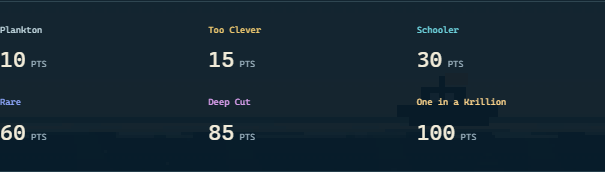
Suppose a familiar answer earns 10 points and a less obvious one earns 60. Finding the second would add 500 more metres to your dive. That’s a worthwhile difference with time to spare. Those values are an example, though. You don’t get to see the price of each guess before you submit. The scoring notes explain how the editors assign a value to an answer. Being the only person in your kitchen who remembers a name is a good story, but it can’t tell you exactly what that name will earn.
A peculiar spelling won’t make a familiar answer more valuable, either. If two names are accepted for the same thing, they share a score. Spend the extra seconds looking for another instrument, dish or place. Writing out a longer version of the one already in your head buys you nothing.
There’s a small catch if you’re treating the answer box as a place to test a hunch. Suppose your adventurous guess earns 15 points. You might have been hoping for 85, but the 15 is yours and that prompt is finished. You can’t withdraw it and try the answer you had in reserve. A second try is available only when the game can’t match the first entry and there’s still time on the clock.
Leave yourself enough time to type twice
The advantage to trying your second idea first is that an unlisted guess can be replaced. The game selects the text, ready for another answer. Say the riskier name comes back unlisted with eight seconds to go. You still have time to type the short answer you kept in mind. Try that same experiment with two seconds left and even knowing the right fallback may do you no good.
The question number matters, too. Say it’s your final prompt, you’re at 3,900 metres and you’d love to reach Abyssal for the first time. Any accepted answer earns at least the 100 metres you need. That’s a fine moment to take the familiar one. At 3,800 metres a 10-pointer leaves you short, so it’s worth looking once more around that music room. The zone depth chart gives you the numbers if you’re aiming at a particular boundary.
With no milestone in mind, the clock makes a perfectly good tie-breaker. If there are two names you could type right now, try the less familiar one. If there’s one name and a half-remembered description, type the name while there’s still time to press Enter.