Why Did My “Obscure” Answer Get Too Clever?
“Too Clever” means your answer counted. In Krillion Unlimited Practice it earns 15 points and takes you down 150 metres. The name is a little joke about the answer people reach for when they’re trying to avoid the obvious one. Something can feel like a great find at your kitchen table and still sit in that tier.
How a second choice can be the obvious second choice
Imagine a group trying a made-up prompt about ice cream. Almost everyone at the table thinks of vanilla. Nobody wants to say vanilla. Two people remember the pistachio tub sitting beside it at the same neighbourhood shop. Both had a perfectly good reason to think they’d come up with something unusual. They also took almost exactly the same route to get there.
That’s the idea behind the label. It helps explain a surprising result without requiring you to believe that people everywhere have the same tastes. A pastry chef, a child buying an ice cream and someone who grew up over that shop would have different first thoughts. The game can recognise the name they type. It has no way to award one of them extra points for how far back they had to reach to remember it. The ice cream example is for illustration and carries no assigned game scores.
Which game gave you the result?
On the official site, the creator describes Too Clever as the familiar pick people make when reaching for an obscure answer. The scoring method varies by prompt. For some subjects, evidence about how often a name appears in written material helps establish familiarity. Others receive a combination of model assistance and manual review. The creator also considers how satisfying the top catch is to discover. The official Krillion FAQ explains those choices.
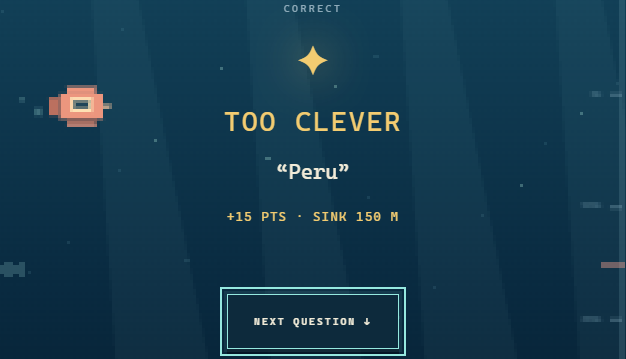
The screenshot above comes from this independent practice site. Here, each accepted answer has a point value assigned for its particular prompt. Look at the result again. It says Peru earned 15 points on that question. It gives you no count of other players who entered Peru. A friend could open the same practice question tomorrow, use the same accepted name and earn the same 15. Playing a second later, typing in capitals or choosing a recognised alias won’t change its tier.
| Part of the reveal | What it tells you |
|---|---|
| Correct | The game matched your entry to an accepted answer for this prompt. |
| The quoted name | This is the answer the game actually judged. Check it if the result surprises you. |
| Too Clever · 15 pts | That answer has the 15-point practice value here. |
| Sink 150 m | Those points added 150 metres to the depth you already had. |
When the points look wrong, read the name first
If the quoted name is the one you meant, the game has understood your answer. You and the editor may simply have different ideas about how familiar it is. For instance, you might know a place from one tiny label in an old atlas. Somebody else might see its name every week in football results. Your own route to the answer is interesting, even when it happens to end at a 15-point catch. The practice scoring notes give the rest of the tier values.
If the display shows a different name, you have a more specific question. Compare what you typed with what appeared on the reveal, especially if a spelling correction was shown. A recognised alias can legitimately resolve to another name for the same thing. If it resolved to something you never intended, open that prompt under Your results after the dive and choose Report an answer issue. Include both spellings. That gives the editor something concrete to check.
What to take into your next dive
On a fresh question, try noticing where your second idea came from. If it’s sitting beside your first one on the same imaginary ice cream counter, give yourself a moment to picture a different shop. A name from another setting might come to mind. If the clock is nearly out and you already have a good answer, take the points. An accepted 15-pointer moves you farther than a brilliant thought you never finish typing.
The next time Too Clever appears, you can read it in order. Check the quoted name, bank the 150 metres, then move on. The decision about whether to risk a rarer guess belongs to the next prompt. This one is already safely in the score.